With Digital Health we means all those paths technology-enabled therapeutics.
It constitutes a bridge between digital technologies and healthcare, it is a real health evolution made possible by the use of technologies such as telemedicine, electronic health records, health apps, electronic health prescriptions, as well as and above all by experimentation of other innovative tools such as Artificial Intelligence, VR/AR, 3D-printing, Internet of Things, robotics and nanotechnology.
At the center of this path there is increasingly the patient, personally involved in the clinical care process, offering greater security in the management of medical records and therapies, a reduction in costs and time spent in care processes and at the same time there will be an improvement access to healthcare, an example of which is telemedicine which will allow remote care leading to a reconfiguration of the doctor-patient relationship.
Increasingly mean focusing on the individual, know their characteristics, needs and lifestyles to develop innovative and personalized treatment plans. Personalization arises from the power of data, from the opportunity to know a set of information that will allow the healthcare system to understand the problem often in advance and provide personalized care for that need. All this is permitted and exemplified by the capacity of technologies themselves to track and analyze in real time a large amount of data that gives life to a person’s medicine based on data: healthcare, reports, clinical history, events, hospitalizations, up to the social aspects of the person(biometric data, lifestyle, wellness, loneliness, integrated with risk indicators), as well as his “skills” (walking, eating independently, cognitive state, etc.).
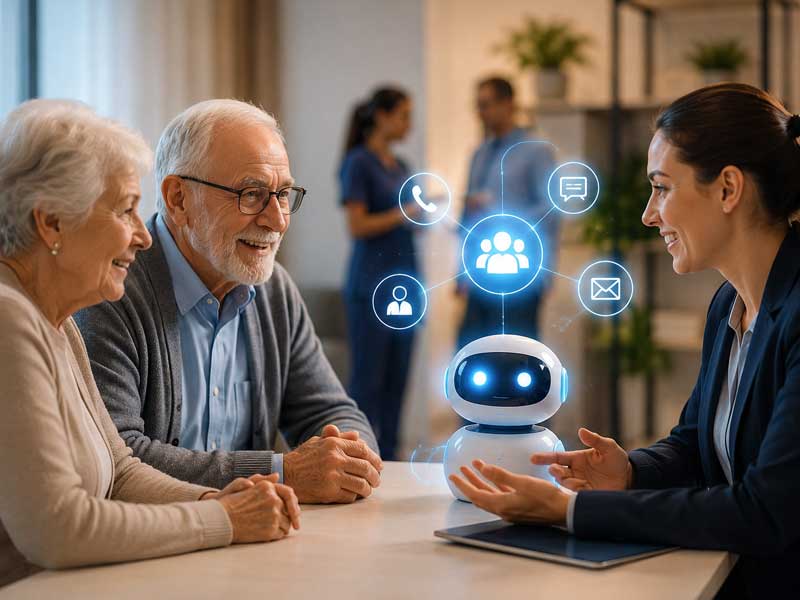
Disruptive technologies can be tools to support both doctors who can save time by delegating the most repetitive tasks to a virtual assistant, and patients, who can have an additional way to communicate with healthcare specialists and to understand.
Base the therapy to follow, these are innovative tools that will increasingly integrate to support a human relationship (doctor-patient) that persists and is maintained. It is important to point out that technology must necessarily be a tool, an enabler but it must not replace the doctor either from a professional point of view or from a relational point of view, also and above all due to the patients’ need for treatment for example, benefit from the presence of a Chatbot for an immediate response, while maintaining the relationship with the doctor who cannot and must not be replaced.
We will therefore increasingly move into an era in which the healthcare sector will become more digitalized, becoming increasingly technological, but which will necessarily see the human component play a central role. To make this happen and succeed, especially to guide the process without having to succumb to it, a current and necessary issue is training related to the doctor’s new skills and his new evolving role.
The need to strengthen digital skills in healthcare is becoming increasingly necessary to bridge the generational gap, and not only that, which exists between the current digital skills of healthcare professionals and those necessary with the advent of new technologies.
Often it is a lack of adequate technical knowledge as well as a widespread resistance to trusting a different approach to traditional and well-known medicine, an attitude that may seem typical of the elderly segment of the population, but in reality, also very present among the new generations of doctors.
It’s necessary to go in this direction in training the future category of healthcare professionals who will have the responsibility of building a new semiotics; identify criteria for predictive models to be integrated into clinical practice; standardize clinical and research databases; define the boundaries of social networks and new communication technologies within healthcare services with basic skills to be integrated with the skills of different professionals such as engineers, physicists, statisticians, mathematicians, for an increasingly holistic and cutting-edge profession.
The acquisition of digital skills thus becomes an integral part of the training path of competent doctors capable of making the most of all the potential that technology offers today, for an increasingly advanced healthcare system that is attentive to the actual needs of patients. The step we will see in these times will be to actively invest in specific training courses that are able to transmit in-depth knowledge on the function and use of technologies, now essential in medicine, by designing and conducting a training course on digital health and digital medicine for professionals employed in various capacities in the pharmaceutical and healthcare sector who want to deepen their technical-scientific background in this field.
On the other hand, digital medicine applications are changing the way of dealing with and managing pathologies, especially chronic ones, preventing or diagnosing diseases, promoting adherence to pharmacological treatment, monitoring adverse events, predicting the course of a disease or the burden of a hospital or department, identify the best treatment, provide therapeutic and rehabilitative interventions and those who don’t keep up with the times… risk being left behind and then catching up won’t be easy.